|
Dataset Title |
Global climatological dataset derived from microwave radiometer satellites |
|
Dataset Purpose |
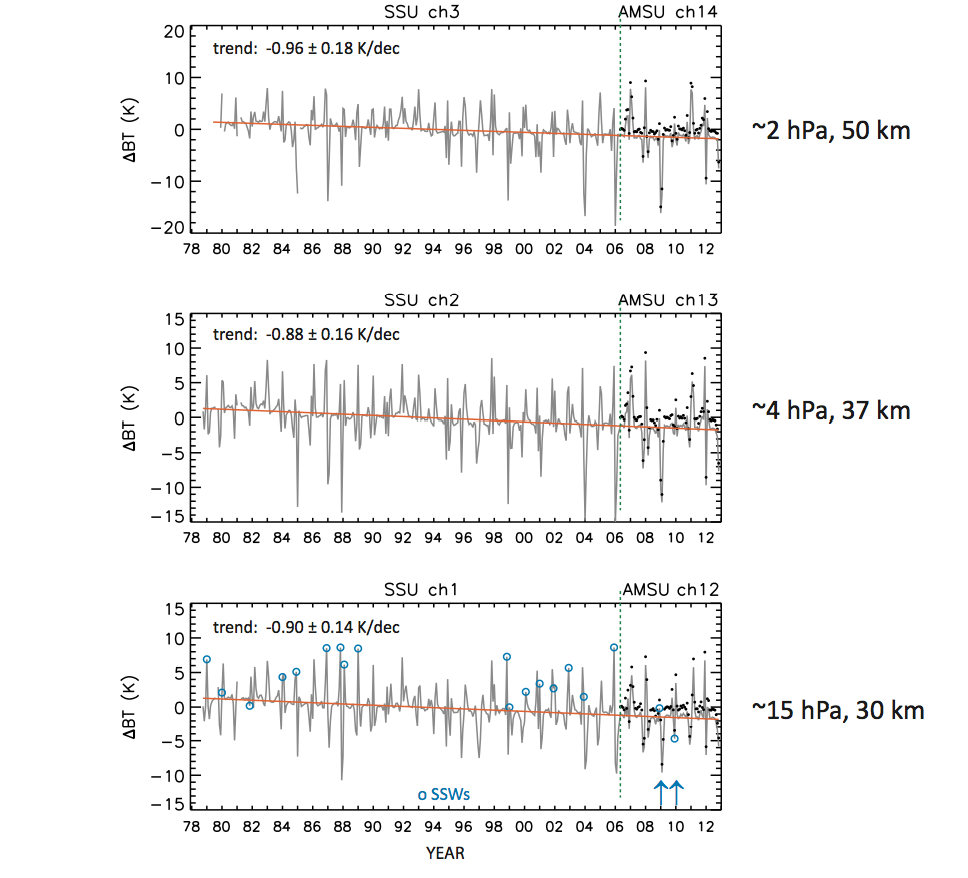
The Advanced Microwave Sounding Unit (AMSU-A), a 15-channel microwave sounder designed primarily to obtain temperature profiles in the upper atmosphere (especially the stratosphere) and to provide a cloud-filtering capability for tropospheric temperature observations. The Advanced Microwave Sounding Unit-B (AMSU-B) is a 5 channel microwave radiometer. The purpose of the instrument is to receive and measure radiation from a number of different layers of the atmosphere in order to obtain global data of precipitation and convection detection. It works in conjunction with the AMSU-A instruments to provide a 20 channel microwave radiometer. The Microwave Humidity Sounder (MHS) together with the complementary AMSU-A instruments, provides the operational microwave sounding capability for the NOAA-18 and 19 meteorological satellites. |
|
Dataset Abstract |
The AMSU-A dataset comprises vertical stratospheric profiles of brightness temperature, while the AMSU-B dataset consists of global data of precipitation and convection detection, both of them from 1998. The MHS (since 20 May 2005) provides humidity profiles and information on surface temperature and emissivity (in conjunction with AMSU-A channels) and detects cloud and precipitation contaminated pixels. The MHS instrument represents an improvement to the AMSU-B radiometer on board previous NOAA satellites, while providing continuity to its data. METOP-C (MHS) will be the next generation of European satellites (2016) and The Advanced Technology Microwave Sounder (ATMS) on board NASA's newest Earth-observing satellite, NPP, acquired its first measurements on November 8, 2011.
|
|
Acquisition Methodology |
The spectrometer is a cross-scanning microwave instrument that is composed of 15 channels between 50 and 58 GHz in the oxygen band, which allows the observation of the temperature structure of the atmosphere from the surface to around 50 km. AMSU-B/MHS moisture channels (3 to 5) detect the presence of hydrometeors through the scattering of radiation, which lowers the brightness temperature compared to its surroundings. Based on this property, combining channels 3 and 5 of AMSU-5 precipitation areas are detected. Areas of deep convection are detected using a criterion initially devised to identify convection in the tropical regions. For the polar regions, because it is colder and drier, the channel convention used for the tropics and Mediterranean areas is not valid. Therefore other channels need to be used for the detection of precipitation and deep convection (channel 4)
|
|
Quality |
There are no specific on-orbit calibration procedures for AMSU-A; the instrument is automatically calibrated each data cycle by measuring both warm and cold calibration targets. AMSU-B data is calibrated. After December 2007 NOAA-15 observations are not used, due to scan asymmetry issues especially for channel 4, which may affect deep convection determination. Also NOAA-16 measurements after December 2007 are ignored due to a residual uncorrected radio-frequency interference and asymmetry problem. For the case of MHS, it is a self-calibrating microwave radiometer.
|
|
Dataset DOI |
|
|
Access Constraints |
AMSU-A level 1C, AMSU-B and MHS data are available for all ICARE registered users. AMSU-A (level B and C), AMSU-B and MHS are also available through ClimServ (Service de donnes et de calcul de L'IPSL).
|
|
Use Constraints |
Raw data like brightness temperature can be used without any constrains. Higher level data, like DC (Deep Convection) or rain occurrence, need to contact the Principal investigator.
|
|
Keywords |
AMSU, MHS, global, microwave radiometers, satellites, climatology data, atmosphere |
|
Status |
In work |
|
Temporal Coverage |
|
|
Start Date |
1998-11-24 |
|
Stop Date |
|